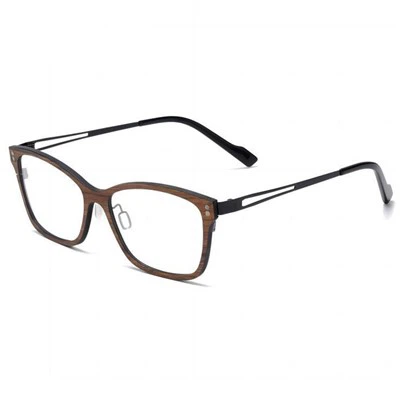
As a manufacturer of carbon fiber eyeglasses, we often receive questions from brand partners about frame durability.Many people wonder: Are carbon fiber eyeglasses more fragile than other materials?In this blog, we explain the real performance of carbon fiber and compare it with other common eyewear materials.
What Is Carbon Fiber?
Carbon fiber is a composite material made of carbon strands reinforced with resin.It is widely known for its excellent strength-to-weight ratio.
This structure gives carbon fiber frames several key advantages:
•Extremely lightweight
•High rigidity
•Good shape stability
•Strong scratch resistance
Lightweight frames improve wearing comfort, while rigidity helps maintain lens alignment and optical performance.
Carbon Fiber vs. Other Frame Materials
Carbon Fiber vs. Metal Frames
Metal frames (stainless steel, titanium, alloy) are strong and corrosion-resistant.However, they can easily bend, dent, or lose shape under pressure or impact.
Carbon fiber is more rigid and more resistant to bending than most metals.It does not dent and holds its shape well during daily use.
The main difference:Carbon fiber is stiffer but can crack or break under strong, sharp impact,whereas metal tends to bend rather than snap.
Carbon Fiber vs. Plastic Frames
Plastic frames are low-cost, flexible, and available in many styles.But they scratch easily, weaken over time, and may become brittle in heat or sunlight.
Carbon fiber is much more scratch-resistant and stable in different environments.It does not age or deform easily.
Like the comparison with metal:Under sudden heavy impact, carbon fiber may break, while plastic often bends.
Key Factors That Affect Carbon Fiber Durability
Manufacturing Quality
High-quality carbon fiber frames have uniform fiber distribution and a stable resin structure.Poor production can create weak points and increase the risk of breaking.As a professional manufacturer, we use strict production control to ensure consistent strength.


Frame Design
The design of the eye glasses also affects their fragility. A frame with complex shapes or thin parts may be more vulnerable to damage. For example, a frame with very thin temples may break more easily than one with thicker, more robust temples. At our company, we pay close attention to the design of our Carbon Fiber Eye Glasses, ensuring that they are both stylish and durable.
Usage and Handling
All frames can be damaged with rough use.With reasonable care, carbon fiber frames have a long service life.
Real - World Performance
In daily use, carbon fiber eyeglasses perform very well.They are lightweight, comfortable, stable, and durable for most scenarios including daily wear and light sports.
Breakage usually only happens under extreme impact -such as being stepped on, crushed, or hit forcefully.In similar conditions, most other frame materials would also be damaged.
Our Product Range
We offer a wide range of Modern Eyeglasses Frames 2026 that are made from high - quality carbon fiber. Our frames are designed to be both fashionable and durable. We use advanced manufacturing techniques to ensure that each frame meets the highest standards of quality.
Our Fiber Eyeglass Frame collection includes various styles, from classic to contemporary. Whether you are looking for a pair of glasses for everyday use or for a specific activity, we have the right frame for you.
Conclusion
Carbon fiber eyeglasses are not inherently more fragile than other materials.
They are stiff, lightweight, scratch-resistant, and stable.While they can break under extreme sharp impact,they perform strongly in daily use and offer unique advantages over metal and plastic.
Durability depends mainly on manufacturing quality, structural design, and proper use.
If you are looking for stable, professional carbon fiber frame manufacturing,welcome to contact us for cooperation, wholesale, or customization.We will provide you with professional product solutions and support.
References
- "Composite Materials in Eyewear: A Review", Journal of Optical Materials
- "The Properties and Applications of Carbon Fiber", Materials Science Quarterly